 n8n
n8n Make
Make Zapier
Designers
Layers, Google fonts, SVG, Pexels, masks, and multi-slide. Social media presets ready to go. Design once and maintain your identity in every variant.
Explore the editor
{
  "templateId": "template_blog",
  "exportFormat": "png",
  "objects": [
    { "id": "text_1", "props": {
      "text": "A space for great ideas."
    } },
    { "id": "image_1", "props": {
      "src": "https://your-cdn.com/blog.jpg"
    } }
  ]
} GUIDE Nº 012 ↗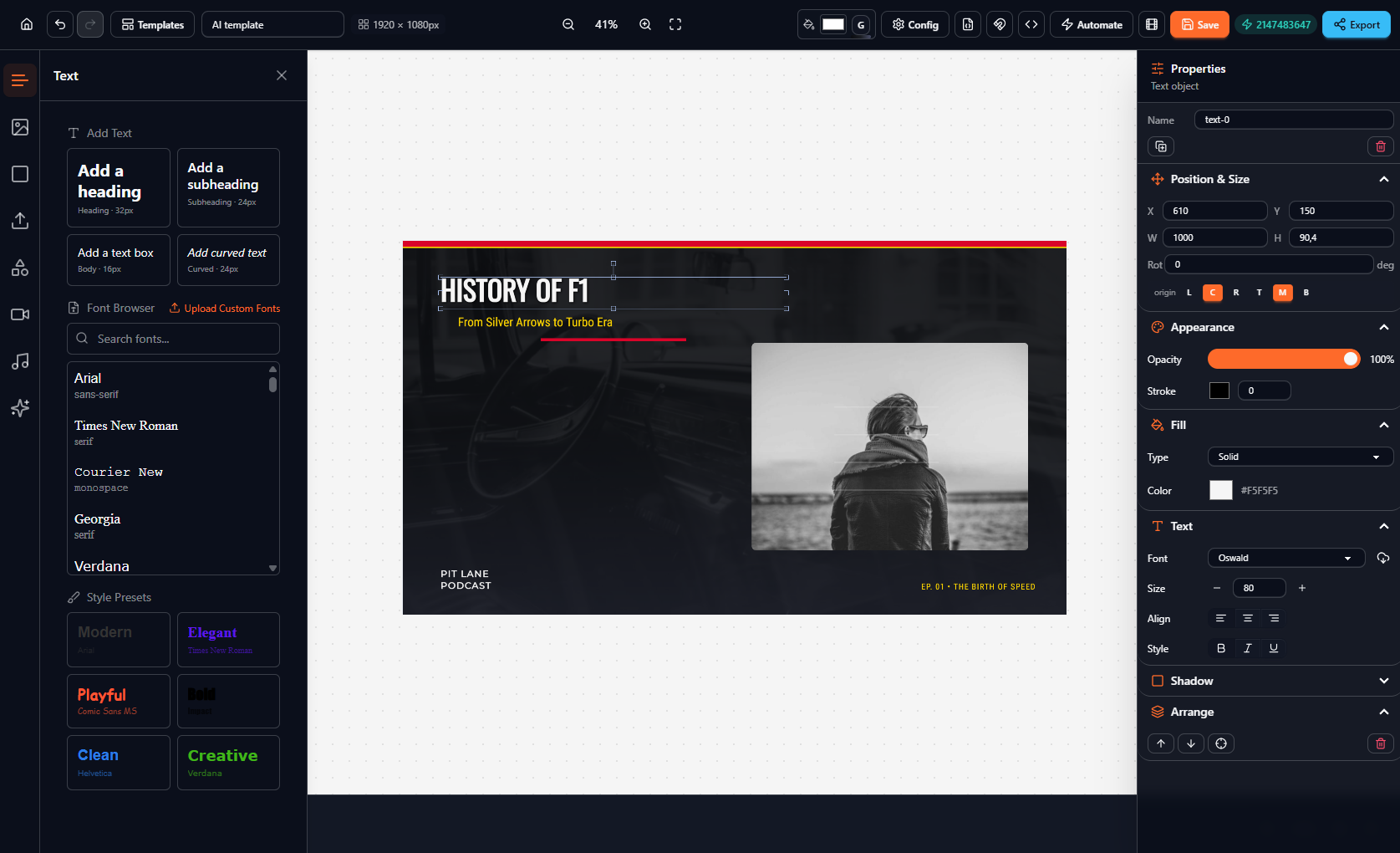
One design, many possibilities.
From your next article to every student's achievement. Choose an example and change its data in the demo.
GUIDE Nº 012 ↗Your next article, ready to share.

A new video. The same identity.
 forma academyLEARN. CREATE. FOLLOW.
For completing the course on Digital Design & AI
Recognition for every student.
Editable sample layouts. Texts, brands, and names used for illustrative purposes.
From canvas to your next launch. Connect your data and let a template do the rest.
Edit the JSON. The result changes instantly.
Choose a row. Or edit its data and generate your own campaign.
Columns: text and image. One row, one image.
Interactive local demo. It does not send requests or webhooks.
The images you upload stay in your browser.
For campaigns, catalogs, certificates
and everything you haven't imagined yet.
Turn what you imagine into a template with text, images, and shapes. The AI generates the design, validates it, and makes it ready to open in the editor. You continue creating from there.
The model generates the canvas JSON and validates it with a schema before saving. The flow is plan → generate → validate → persist. If necessary, split and combine the response into parts; if validation fails, try to correct it.
From a phrase to a designIllustrative example«Instagram post for Black Friday, 50% off, dark background, large red text»
forma academyLEARN. CREATE. FOLLOW.For completing the course on Digital Design & AI
Illustrative view of the flow. Try real generation within Pikstrapi.
A published article. A completed course. A new row. Turn every event into an image with your favorite automation.
Pikstrapi generatesYour template + new dataIn n8n, add an HTTP Request node with your API key and the template JSON. Use a Webhook node to receive the result in deferred mode.
See how to connectAn editable demo with results you can download.
Adjust the template in the editor. Decide what changes with each render.
Have you tried it yet? Tell us about your experience ↗
A shared journey for your creative team, your data, and your tools.
Create your template in the editor or start with AI. Mark the texts and images that will change in each variant.
Send your data via API, prepare a flow in n8n, or share your template's form.
Pikstrapi applies the data and generates the image. One variant or an entire bulk render, with the same design.
Get the PNG URL or receive a webhook when finished. Your image is ready to publish, send, or save.
Renders run in headless Chrome, with jobs queued via BullMQ. Pikstrapi manages this infrastructure. The API uses API keys and supports deferred delivery via webhook, with retries and HMAC signing when you configure a secret.
Share a template's fields. Marketing fills in names, texts, or images and generates new versions without opening the editor.
Try with a certificateEveryone works their own way.
The template keeps the whole team connected.
Layers, Google fonts, SVG, Pexels, masks, and multi-slide. Social media presets ready to go. Design once and maintain your identity in every variant.
Explore the editorREST API with API key, bulk renders, and webhooks with retries and configurable HMAC signing. Examples in JS, Python, cURL, and PHP. No render server management.
Try the APIOne form per template. Fill in fields, generate variants, and launch your campaign without asking the design team for every change.
Discover the formsn8n, Zapier, or Make, connected via API and webhooks. A new catalog, a completed course, or a scheduled promo trigger the render.
Connect your workflowCreativity and code. Finally, the same language.
Find your way to get startedChoose the credits you need today.
Your next campaign can be bigger.
To give shape to your first idea.
To give shape to your first idea.
To turn ideas into a flow.
To produce at another scale.
1 image = 1 credit. AI and video consume credits based on the work. Check the amount and applicable taxes before paying.
Tell us how many renders you need and we'll find the right quota.
Not for designing or generating images with forms. The editor is visual. To integrate the API, you need to connect your requests or an automation flow.
You create a template and use data from a CSV to produce its variants in bulk. Each row provides the data for one image.
Yes. You send an array of objects with each object's ID and its props: for example, 'text' to change text or 'src' to replace an image. Add mode: "deferred" and webhookUrl to use a webhook.
Yes, using their HTTP modules and webhooks. Send your template's JSON to the Pikstrapi API and receive the generated image. The connection is configured in your tool; it does not require a native Pikstrapi connector.
The AI validates the design and can attempt to correct it. Credits are only consumed when the template is successfully rendered and saved. If the process fails, you don't pay for that render.
PNG, JPEG, WebP, SVG, and PDF. Choose the format based on where you will use the design.
Yes. The free plan includes 50 renders per month, one template, and an API key. You can create your account without a card.
Your next image is just the beginning.